 St. Petersburg Roofing
 Why Childs Park Homes Take a Beating from the Outside In
Childs Park is one of St. Petersburg's older, established neighborhoods, and that means a lot of the homes here have exterior walls that have already been through decades of Pinellas County weather. Florida's Gulf Coast climate doesn't give siding an easy life: hurricane-force winds during tropical systems, wind-driven rain that gets pushed sideways into wall assemblies, intense UV exposure nearly every day of the year, and a steady dose of salt air drifting in off Tampa Bay and the Gulf. Each of those factors attacks siding differently, and each one shows up in the same places over and over — cupped or delaminating panels, chalky faded paint, soft spots around window trim, and siding that's pulling away at the corners.
When we're asked to look at a Childs Park home, we're rarely dealing with a single problem. It's usually a combination: sun-baked siding on the west and south exposures, moisture damage low on the wall where sprinklers or drainage keep it damp, and wind damage around eaves and corners from the last storm season. Fiber cement siding, installed correctly, is built to hold up against all of that at once — but "installed correctly" is doing a lot of work in that sentence, and it's the part that gets skipped more often than homeowners realize.
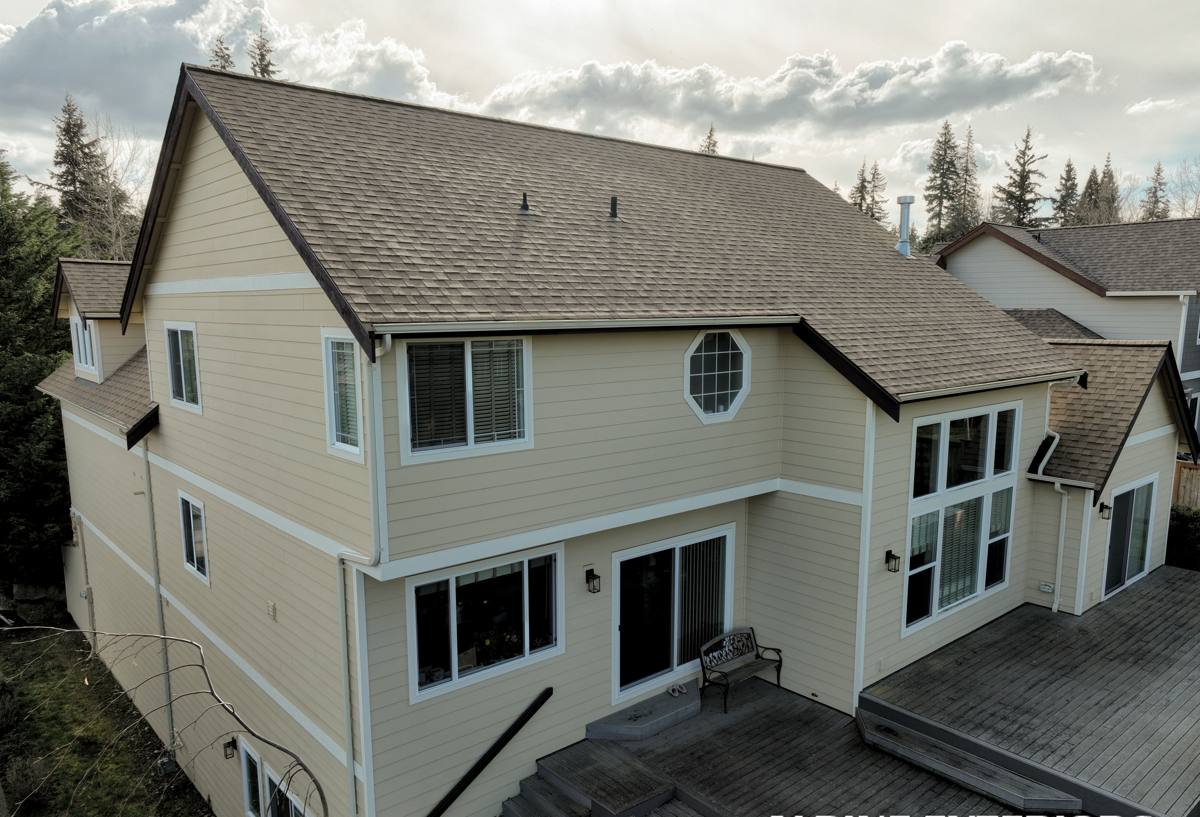
What This Climate Actually Requires from a Siding Product
Wind resistance that doesn't rely on caulk
Siding on a St. Petersburg home needs to stay attached through sustained tropical storm and hurricane winds, not just look good on a calm day. That comes down to fastener count, fastener placement, and how the panels lap and lock together — not the material alone. A wind-rated product installed with the wrong nailing pattern still fails in a storm.
Moisture behavior, not just moisture resistance
Wind-driven rain in this region doesn't just hit siding — it gets forced behind it, up under laps, and around penetrations. The material needs to handle incidental moisture without swelling, rotting, or feeding mold, and the assembly behind it (house wrap, flashing, drainage plane) needs to let any water that does get in find its way back out.
UV stability without constant repainting
Florida sun degrades standard paint finishes faster than almost anywhere else in the country. A finish that chalks, fades, or peels within a few years turns siding into a maintenance chore instead of a long-term exterior.
Salt air tolerance
Even set back from the immediate coastline, homes throughout St. Petersburg and Pinellas County are exposed to airborne salt that accelerates corrosion on fasteners and hardware and breaks down materials that aren't built to shrug it off.
Why We Only Install James Hardie Fiber Cement
We don't install vinyl, LP SmartSide, primed wood, or other fiber cement brands. That's a deliberate standard, not a sales pitch. Vinyl softens and warps under sustained heat and can crack in high wind. Engineered wood products are more vulnerable to moisture intrusion at cut edges and seams, which is a real liability in a climate with this much wind-driven rain. Other fiber cement brands may be reasonable products, but we've built our installation training, our fastening specs, and our warranty relationships around one system, and we'd rather be genuinely expert in one product than average across several.
James Hardie fiber cement is non-combustible, dimensionally stable in heat and humidity, and comes with a factory-applied ColorPlus finish baked on under controlled conditions rather than field-painted. That finish is engineered specifically to resist UV fading — a real advantage in a market where the sun is the enemy nearly 365 days a year. Hardie also builds region-specific product engineering into its HZ5 and HZ10 lines, tuning moisture and climate performance to where the siding is actually going to hang.
The HZ10 Engineering Behind What Goes on Your Wall
James Hardie engineers its siding for different climate zones, and Pinellas County falls into the HZ10 zone — the classification built for hot, humid, high-moisture Gulf and Southeast coastal conditions. That's not a marketing label; it affects the product's formulation and moisture performance. Installing an HZ5 (cooler, drier climate) product on a Childs Park home would be a mismatch, and it's one more reason product selection matters as much as installation quality.
| Concern | What HZ10-engineered Hardie siding addresses |
|---|---|
| High humidity, near-constant moisture in the air | Formulated for moisture resistance without swelling or softening |
| Intense, near year-round UV | Factory ColorPlus finish resists fading, chalking, and cracking |
| Wind-driven rain during tropical systems | Panel design pairs with correct flashing and lap detailing to shed water |
| Salt-laden coastal air | Fiber cement composition doesn't corrode like metal siding or fasteners can |
| Sustained tropical storm and hurricane winds | Rated for high wind loads when fastened to manufacturer spec |
What a Correct Installation Involves
The siding itself is only half the job. We see plenty of homes where decent material was installed poorly, and the failures that show up a few years later trace straight back to shortcuts most homeowners couldn't have spotted at the time.
Water management comes first
Before a single piece of siding goes up, the wall needs a proper weather-resistive barrier, correctly lapped and taped, with flashing installed at every window, door, and horizontal trim transition so water is directed out and down rather than trapped behind the cladding.
Clearances that actually get followed
Hardie's specifications call for minimum clearances between the bottom of the siding and roof lines, decks, and grade. Skipping these clearances to save trim work is one of the most common causes of moisture damage we find on older homes in this area, and it's invisible until the damage is already done.
Fastening for wind, not just for now
Correct fastener type, spacing, and embedment depth are what keep siding attached through a tropical storm. We follow manufacturer fastening schedules rather than field-guessing, especially at corners, edges, and high-exposure elevations.
Caulking and sealant, used correctly and sparingly
Caulk has a place at specific joints and penetrations, but it's not a substitute for proper flashing and lapping. Over-reliance on sealant is a red flag — it means water management is being patched over instead of built in, and sealant is the first thing to fail in Florida heat.
Our Process for a Childs Park Project
- On-site assessment — we walk the exterior, check for existing moisture or wind damage, and evaluate the wall assembly underneath, not just the visible siding.
- Product and color selection — HZ10-engineered Hardie boards or panels in the profile and ColorPlus finish that fits the home.
- Tear-off and substrate check — old siding comes off and we inspect sheathing for rot or damage before anything new goes up.
- Weather barrier and flashing — house wrap, window and door flashing, and trim flashing installed to manufacturer spec.
- Siding installation — fastened per Hardie's wind-zone requirements, with correct clearances at every transition.
- Final detailing and walkthrough — trim, caulking at appropriate joints only, and a final inspection with the homeowner.
What Drives Cost on a Project Like This
| Factor | Why it matters |
|---|---|
| Home size and wall complexity | More corners, gables, and trim details mean more labor and cut waste |
| Substrate condition | Rotted sheathing found during tear-off has to be replaced before new siding goes on |
| Siding profile (lap, shingle, panel) | Labor time and material cost vary by profile and reveal size |
| Trim and accessory scope | Corner boards, window trim, and fascia work add to the total |
| Access and site conditions | Tight lots, mature landscaping, or two-story walls affect labor and equipment needs |
We won't quote a project without seeing the home, but we're happy to talk through rough ranges and what's driving them once we've walked the exterior.
Why Hiring a Crew That Already Works This Neighborhood Matters
Childs Park has a mix of home ages and construction styles, and a crew that's worked in the neighborhood already has a feel for what's usually hiding under the existing siding — older sheathing, past patch repairs, or wall assemblies that were built to a different code era. That context shortens the assessment phase and reduces surprises once tear-off starts. It also means we're familiar with how St. Petersburg and Pinellas County permitting and inspection processes work for exterior projects, which keeps a job moving instead of stalling on paperwork.
Local experience also means understanding how a specific street's sun exposure, tree cover, or proximity to the water changes what a home needs. A house a few blocks from open water deals with more salt exposure than one further inland, even within the same neighborhood, and that can factor into product and detailing choices.
Keeping Fiber Cement Siding Performing Long-Term
Correctly installed Hardie siding is low-maintenance, not no-maintenance. A little attention keeps it performing for decades in this climate:
- Rinse siding periodically to clear salt residue and airborne grime, especially on homes closer to the water
- Keep sprinklers and irrigation heads from spraying directly on siding
- Trim back landscaping so it isn't holding moisture against the wall
- Check caulking at trim joints and penetrations annually and touch up as needed
- After major storms, walk the exterior for loose panels, damaged corners, or displaced trim
- Address any soft spots or discoloration promptly rather than waiting
If your Childs Park home's siding is showing sun damage, storm wear, or moisture problems, we're glad to take a look and walk you through what we're seeing and what it would take to fix it right. Reach out for a free, no-pressure estimate — there's a form below to get started.