 St. Petersburg Roofing
 Deck Replacement Built for a Waterfront Neighborhood
Coquina Key sits on the water, and that changes what a deck has to survive. A deck built the same way you'd build one five miles inland won't hold up the same way here. Between the humidity coming off the canals, the salt in the air, and the amount of direct Florida sun these decks take year-round, the boards, fasteners, and framing underneath take a beating that a typical suburban backyard deck never sees. When we replace a deck in this part of St. Petersburg, we're not just swapping old boards for new ones — we're building for the specific conditions of a Pinellas County canal-front lot.
Salt Air and Metal Fasteners
Salt-laden air doesn't stay near the water's edge — it travels with the breeze and settles on everything, including the nails, screws, and joist hangers holding a deck together. Standard zinc-coated fasteners that would last decades inland can start corroding within a few years this close to saltwater. Once fasteners weaken, the connection between the deck and the house — or between the deck boards and the joists — weakens with them, and that's a safety issue, not just a cosmetic one.
Sun, Rain, and Wood Movement
Florida decks live in a cycle of intense UV exposure followed by sudden, heavy rain, day after day. That cycle dries wood out, then swells it back up, over and over. Over time this movement loosens fasteners, opens gaps between boards, and accelerates checking and splintering on wood decking. Add in the wind-driven rain that comes with our storm season, and moisture finds its way into every joint and screw hole that isn't properly sealed or flashed.
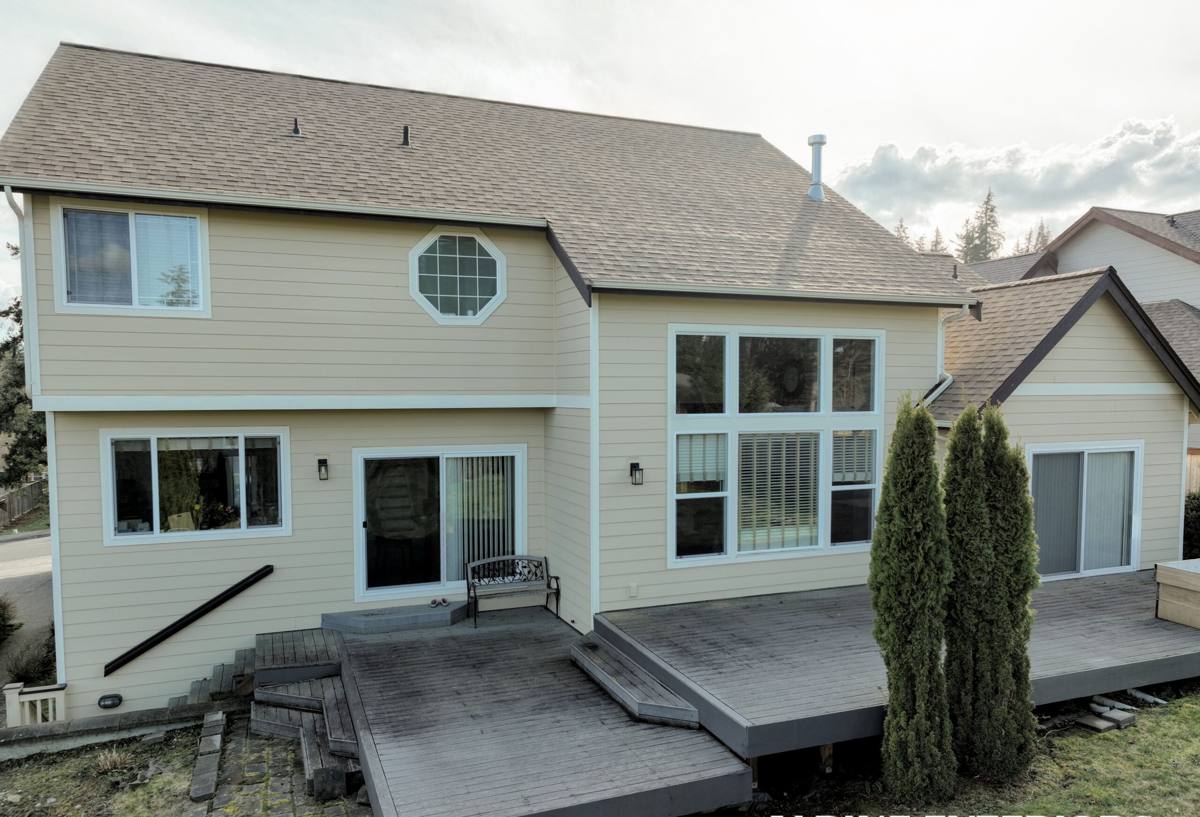
Signs a Deck Needs Replacement, Not Just a Repair
Homeowners often ask whether they can get away with patching a board or two. Sometimes that's true. But once certain problems show up, patching is a short-term fix on a structure that's already failing underneath. Here's what tells us a deck is past the point of spot repair:
- Soft, spongy, or spring-loaded spots when you walk across the deck
- Visible rot or discoloration at the ledger board where the deck meets the house
- Rusted, stained, or corroded fasteners and joist hangers visible from underneath
- Posts or footings that have shifted, settled, or show cracking at the base
- Railings that flex or feel loose when leaned on
- Gaps between boards that have widened significantly since installation
- A deck that was never properly flashed at the house connection, allowing water intrusion behind siding
If you're seeing two or more of these, the framing underneath is usually further along in its decline than the surface boards let on.
What a Correct Deck Replacement Actually Involves
A deck replacement is more than new decking boards laid over an existing frame. Done right, it's a full evaluation of everything from the house connection down to the footings, with an eye toward what this specific location and climate demand.
The Ledger Board and Structural Framing
The ledger board — where the deck attaches to the house — is the single most important structural connection on most decks, and it's also the most common point of failure. It needs proper flashing to keep water from getting behind it and into the home's structure, and it needs to be through-bolted or lag-screwed according to load requirements, not just nailed. We inspect this connection closely on every replacement, because a deck can look fine on top while this connection is quietly failing underneath.
Footings and Post Depth
Florida's building code sets minimum depth and bearing requirements for deck footings, and those requirements exist for a reason — shallow or undersized footings shift over time, especially in areas with sandy or wet soil common near canals and low-lying lots. We size and set footings to meet code for the load the deck will actually carry, not just to match whatever was there before.
Fasteners and Hardware
Given the salt air discussed above, we don't use standard-grade fasteners on waterfront or near-waterfront deck rebuilds. Stainless steel or hot-dip galvanized hardware costs more upfront, but it's the difference between hardware that lasts the life of the deck and hardware that needs to be inspected and replaced again in a few years. This is one of the places where cutting corners doesn't save money in the long run — it just moves the cost down the road.
Choosing the Right Decking Material
There's no single "best" decking material — there's a best material for your budget, your maintenance tolerance, and this climate. Here's how the common options compare for a canal-front St. Petersburg property:
| Material | Upfront Cost | Maintenance | Performance in Salt Air & UV |
|---|---|---|---|
| Pressure-treated pine | Lowest | Needs regular sealing/staining, roughly every 1-3 years | Prone to graying, splintering, and checking without upkeep; wood movement common |
| Composite decking | Mid-to-high | Low — occasional cleaning, no staining | Handles UV and moisture well; quality varies significantly by product line |
| PVC/capstock decking | Highest | Lowest — largely wipe-clean | Very strong resistance to moisture and salt exposure, doesn't absorb water like wood-based composites |
| Hardwood (e.g., tropical species) | High | Moderate-to-high, periodic oiling | Naturally dense and rot-resistant, but still needs maintenance in intense sun |
We'll talk through these trade-offs honestly based on how you actually use the deck and how much upkeep you want to take on — there's no reason to pay for a premium material if a well-maintained pressure-treated deck fits your needs, and no reason to accept high maintenance if you'd rather not deal with it.
Permits and Working Near the Canals
Deck replacement in St. Petersburg generally requires a permit, and that's especially true for waterfront and canal-front properties in a neighborhood like Coquina Key, where setback rules and proximity to the water can affect what's allowed. We handle the permitting process as part of the job — pulling the right permit, scheduling required inspections, and making sure the finished work will pass. Skipping permits on a deck rebuild isn't just a paperwork risk; it can create real problems later when you sell the home or file an insurance claim.
Building for Wind, Not Just Weather
Pinellas County sits squarely in hurricane country, and a deck attached to your home is, structurally, an extension of your home. During high wind events, an improperly attached deck can rack, twist, or pull away from the house entirely — and that's a hazard to the structure and to anyone on it. Proper hurricane-rated connectors, correctly spaced fasteners, and a ledger connection built to code aren't optional upgrades on a Coquina Key deck; they're baseline requirements for a deck that's meant to last through our storm season, not just look good on a calm day.
Our Process for a Coquina Key Deck Replacement
- On-site evaluation — we inspect the existing deck, ledger connection, framing, and footings to see what's actually driving the failure, not just what's visible on the surface.
- Material and design discussion — we walk through decking options, railing choices, and layout based on your budget and how you use the space.
- Permitting — we handle the permit application and coordinate required inspections with the city.
- Demolition and disposal — the old deck is removed and hauled off, and we check for any hidden damage to the house structure behind the ledger board.
- Framing and footings — new or reinforced footings, posts, and joists are set to current code, sized for the deck's actual load.
- Decking, railing, and hardware installation — using corrosion-resistant fasteners appropriate for a saltwater-adjacent property.
- Final walkthrough and inspection sign-off — we confirm the finished deck passes inspection and walk the property with you before calling the job done.
Why a Crew That Already Works This Neighborhood Matters
A contractor who's worked on decks throughout St. Petersburg's waterfront communities already knows what fails first on a canal-front lot, what the city's inspectors look for on these permits, and which materials actually hold up here versus which ones look good on a spec sheet but struggle in salt air. That's a different starting point than a crew working from a generic playbook built for inland, low-humidity conditions. It means fewer surprises during the job and a deck that's built for the conditions it will actually face, not the conditions decking manufacturers test under in a lab somewhere else.
Keeping Your New Deck in Good Shape
Whatever material you choose, a little routine attention goes a long way in this climate. Rinse off salt residue periodically, keep an eye on the area where the deck meets the house for any signs of moisture intrusion, and don't ignore small issues like a loose board or a slightly raised fastener — in this environment, small problems compound faster than they would elsewhere. A well-built deck with reasonable upkeep should give you many years of use before it needs major work again.
If your deck in Coquina Key is showing its age — or you're just not sure whether it needs repair or full replacement — we're happy to take a look and give you an honest assessment. Fill out the form below for a free, no-pressure estimate.